Base gravel for patios and walkways · depth, yards, tons
Paver base calculator
Enter the patio or walkway size and base depth to calculate paver base in cubic yards and US tons. ICPI’s minimum is 4 inches of compacted base under a patio and 6 inches under a driveway, and the base runs past the paved edge by its own depth.
How much paver base you need
Enter your dimensions to see cubic yards, tons and bags
The short answer
How much paver base do I need?
Multiply length × width in feet by depth in inches, then divide by 324 for cubic yards. A 12 × 12 ft patio at 4 in needs 48 ft³, or 1.78 cubic yards, which is about 2.4 US tons at the Pavingstone Supply figure of 2,700 lb per cubic yard (1.35 tons per yard). Dig past the edge too: on a 4 inch base, the 12 × 12 ft patio’s base covers 160.44 ft², 11.4% more than the patio.
Base thickness
How thick should paver base be?
At least 4 inches of compacted base under a patio or walkway and 6 inches under a residential driveway, on well-drained soil. That is the Interlocking Concrete Pavement Institute’s minimum; cold climates and wet or weak soils need 2 to 4 inches more. CMHA gives the same minimums; Unilock’s are higher for driveways, and the bag instructions are lower.
| Source | Patio or walkway | Driveway | Adjust for |
|---|---|---|---|
| ICPI Tech Spec 2 | 4 in minimum | 6 in minimum | 2–4 in thicker in colder climates or on continually wet or weak soils |
| CMHA (2025) | 4 in | 6 in | Add 50% for each ideal condition your site lacks: strong soil, drainage, no freezing |
| Unilock | 4–6 in | 8–12 in | Clay generally needs to be dug deeper |
| QUIKRETE bagged-paver instructions | 2–4 in of No. 1151 gravel | Not covered | Excavate 4–7 in below finished grade in total |
CMHA’s 50% rule, worked out
| Ideal conditions missing | Patio | Driveway |
|---|---|---|
| 0 | 4 in | 6 in |
| 1 | 6 in | 9 in |
| 2 | 8 in | 12 in |
| 3 | 10 in | 15 in |
QUIKRETE’s paver-sand data sheet calls for 2 to 4 inches of its No. 1151 All-Purpose Gravel, which it describes as clean gravel with a top size of about ⅜ inch. That is below ICPI’s 4 inch minimum, and a clean ⅜ inch gravel is not the dense-graded base in the ASTM D2940 grading below.
The calculation
How to calculate paver base
- Choose the compacted base depth.At least 4 inches under a patio or walkway and 6 inches under a driveway on well-drained soil (ICPI); add 2 to 4 inches in cold climates or on wet or weak soil.
- Extend the base past the edge.Add the base depth to every side: a 20 × 10 ft patio on a 6 inch base needs a 21 × 11 ft base, 15.5% more area.
- Convert to loose cubic yards.Base length × width × depth in inches ÷ 324, then add the compaction allowance: 20% on one supplier’s advice.
- Add the bedding sand separately.1 inch of sand over the paved area only, left loose until the pavers go down (ICPI). It is a different material, so estimate it on its own.
Rectangle · US measurements
Length × Width × Depth ÷ 324
Feet × feet × inches → cubic yards
Cubic yards × 2,700 ÷ 2,000
Cubic yards × lb/yd³ → US tons at the reference weight
Read the full calculation method ↗Worked examples
Paver base calculator examples
At 100 lb/ft³, before any allowance. Open one to load it into the calculator.
| Project | Volume | Weight |
|---|---|---|
| 12 × 12 ft patio at 4 in | 48 ft³ · 1.78 yd³ | 2.4 US tons |
| 20 × 3 ft walkway at 4 in | 20 ft³ · 0.74 yd³ | 1 US tons |
| 20 × 16 ft patio at 6 in | 160 ft³ · 5.93 yd³ | 8 US tons |
Bulk quantities
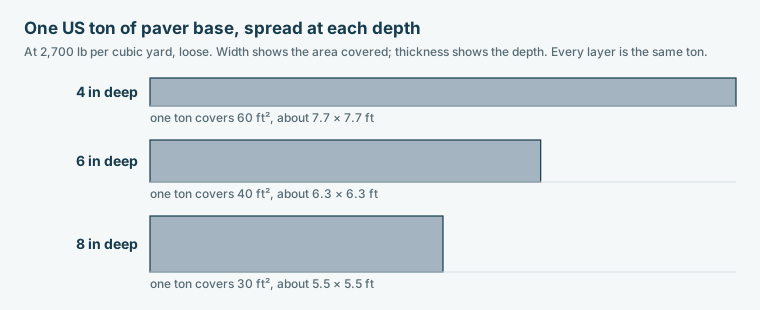
How much does a ton or a cubic yard of paver base cover?
One US ton at 2,700 lb per cubic yard is 0.74 cubic yards (20 ft³).
| Depth | One US ton covers | Tons for 100 ft² |
|---|---|---|
| 4 in | 60 ft² | 1.67 tons |
| 6 in | 40 ft² | 2.5 tons |
| 8 in | 30 ft² | 3.33 tons |
Why the density matters
How much does a yard of paver base weigh?
One cubic yard of paver base weighs 2,500 to 3,000 lb (1.25 to 1.5 US tons) across the published figures below, and 2,700 lb (1.35 US tons) at the calculator’s preset.
| Product | Publisher | lb per yd³ | Tons per yd³ |
|---|---|---|---|
| Crushed base gravel (1/4 and 5/8 inch minus paver base) | Pavingstone Supply | 2,700 | 1.35 |
| 3/4 inch Minus Crushed Quarry | Landscape Shoppe | 2,500 | 1.25 |
| Road Mix (3/4 inch crushed limestone with screenings, CA6) | Tim Wallace Landscape Supply | 3,000 | 1.5 |
Enter your supplier’s figure under Material & allowance. For gravel in general, see how much a yard of gravel weighs, which lists each supplier weight per yard in our ledger with its source and recorded date.
Past the edge
How much base to dig past the paved edge
Unilock’s rule is that the base extends past the paved edge by a distance equal to its depth, on every side. The extra looks small but adds up on narrow areas:
| Paved area | Base dug | Extra area | Base volume |
|---|---|---|---|
| 12 × 12 ft patio at 4 in | 12.67 × 12.67 ft | +11.4% | 1.98 yd³ · 2.67 tons |
| 20 × 3 ft walkway at 4 in | 20.67 × 3.67 ft | +26.3% | 0.94 yd³ · 1.26 tons |
| 20 × 16 ft patio at 6 in | 21 × 17 ft | +11.6% | 6.61 yd³ · 8.93 tons |
Bedding sand is a separate line
ICPI screeds the bedding sand to a nominal 1 inch and leaves it loose until the pavers are laid; it is not a way to level an uneven base. At 1 inch that is 8.33 ft³ per 100 ft² of paving, over the paved area only.
Compaction
Compacting paver base: lifts, density and the right gravel
ICPI spreads and compacts the base in 4 to 6 inch lifts with a 7,000 lbf reversible plate compactor, to at least 98% of standard Proctor density for patios and residential driveways, and a finished surface within ±⅜ inch under a 10 ft straightedge. CMHA calls a plate under 5,000 lbf too small. Order loose material to cover the loss: 20% on one supplier’s advice, about 25% from WSDOT’s loose and compacted weights; the road base calculator tabulates the loose depth for each compacted depth.
| Sieve | % passing |
|---|---|
| 2 in | 100 |
| 1½ in | 95–100 |
| ¾ in | 70–92 |
| ⅜ in | 50–70 |
| No. 4 | 35–55 |
| No. 30 | 12–25 |
| No. 200 | 0–8 |
Ask the yard whether its paver base meets this grading. CMHA warns against stone dust, screenings and rounded stone such as river rock or pea gravel. For a firm decorative surface without pavers, see the decomposed granite calculator.
Before you order
Frequently asked questions about paver base
How much sand do I need under pavers?
ICPI calls for a bedding layer screeded to a nominal 1 inch and left uncompacted until the pavers go on. That is 8.33 ft³ (0.31 yd³) per 100 ft² of paving; a 12 × 12 ft patio needs 12 ft³, or 0.44 yd³. QUIKRETE’s bag instructions allow 1 to 2 inches.
How many bags of paver base do I need?
Bagged base is sold by weight. At 100 lb per cubic foot, a 50 lb bag holds 0.5 ft³. A 20 × 3 ft walkway at 4 in takes 20 ft³, or 40 bags, before the edge overhang or any allowance; 100 ft² at 4 inches takes 67.
How much extra paver base should I order for compaction?
Tim Wallace Landscape Supply advises adding 20% for compaction. WSDOT’s published loose and compacted weights for crushed base course imply about 25%. Enter the allowance your supplier recommends under Material & allowance; the calculator adds it to both volume and weight.
How many tons of paver base per cubic yard?
The published figures on this page run from 2,500 lb (1.25 tons) to 3,000 lb (1.5 tons) per cubic yard, loose. Pavingstone Supply describes its 2,700 lb figure as an average that varies by material.
What gravel should I use for paver base?
Dense-graded crushed aggregate meeting ASTM D2940, the grading ICPI and CMHA both point to: crushed stone from 2 inches down to fines, with 0–8% passing the No. 200 sieve. CMHA says never to use stone dust or screenings, and not to use rounded aggregate such as river rock or pea gravel.
What size plate compactor do I need for paver base?
ICPI compacts the base in 4 to 6 inch lifts with a 7,000 lbf reversible plate compactor, and thinner lifts with a smaller machine. CMHA calls a plate under 5,000 lbf too small. The target is 98% of standard Proctor density for patios and residential driveways.
References
- Crushed base gravel (1/4 and 5/8 inch minus paver base): 2,700 lb/yd³, Pavingstone Supply. Recorded September 23, 2026
- 3/4 inch Minus Crushed Quarry: 2,500 lb/yd³, Landscape Shoppe. Recorded September 23, 2026
- Road Mix (3/4 inch crushed limestone with screenings, CA6): 1.5 US tons/yd³, Tim Wallace Landscape Supply. Recorded September 23, 2026
- Tech Spec 2: Construction of Interlocking Concrete Pavements (revised February 2020; dealer-hosted copy), Interlocking Concrete Pavement Institute. Checked September 24, 2026
- Proper Concrete Paver Base and Depth (Bryan Horr, P.E., May 23, 2025), Concrete Masonry & Hardscapes Association. Checked September 24, 2026
- Dos and don’ts of paver installation: base preparation, Unilock. Checked September 24, 2026
- Patio Paver Sands No. 1150 data sheet, QUIKRETE. Checked September 24, 2026
- Sand & Gravel Products data sheet (All-Purpose Gravel No. 1151), QUIKRETE. Checked September 24, 2026
About these calculations
Written with AI assistance from the sources listed on this page. Each figure links to its source; recorded dates are shown with the figures or in the gravel weight and price ledgers, and the arithmetic is covered by automated tests. The 2,700 lb per cubic yard preset is Pavingstone Supply’s published average for its crushed base gravels. How this page was made · Report an error