A practical tool for your next project
Gravel calculator
Enter length, width and depth to get gravel in cubic yards, US tons and bags. General gravel weighs about 1.42 tons per cubic yard at 105 lb/ft³;
use your supplier’s density for a closer estimate.
How much gravel you need
Enter your dimensions to see cubic yards, tons and bags
The calculation
How to calculate how much gravel you need
Use this gravel estimator for driveway layers, garden paths and landscaping areas. It calculates gravel yardage from dimensions, tonnage from bulk density, and bags or cost from your package size and quote. Keep different materials in separate estimates.
- Measure your space.Choose a rectangle, circle, known area or known volume. Add more areas when they will use the same material.
- Set depth and density.Enter the intended layer depth. Check the bulk density with your supplier before relying on the weight estimate.
- Take the estimate with you.Copy the quantities and assumptions, print your order summary, or share a link that restores your measurements.
Planning a path or patio with pea gravel? The pea gravel calculator starts with a sourced density and counts bags. For a driveway layer, the gravel driveway calculator adds a length table and compaction arithmetic.
Rectangle · US measurements
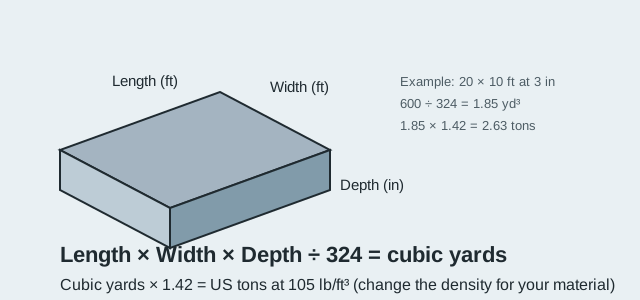
Length × Width × Depth ÷ 324
Feet × feet × inches → cubic yards
Read the full calculation method ↗A worked example
Gravel calculation example: 20 × 10 ft at 3 inches
With no extra allowance and a bulk density of 105 lb/ft³, here is what the calculation produces.
Try these measurements above ↑| Surface area | 200 ft² |
|---|---|
| Volume | 50 ft³ / 1.85 yd³ |
| Estimated weight | 5,250 lb / 2.63 US tons |
| 0.5 ft³ bags | 100 bags |
At a hypothetical quote of $50 per cubic yard plus $75 delivery, the unrounded volume costs $167.59.
Quick reference · US units
Gravel yardage, tonnage and coverage charts
These tables use 105 lb/ft³, 0% extra allowance and no compaction adjustment. Bags contain 0.5 ft³. They are fixed examples; changing the calculator above does not change these tables. Use your supplier’s density for an order, and compare published supplier densities if you do not have one yet.
Cubic yards to tons at 105 lb/ft³
At this density, 1 yd³ weighs 2,835 lb, or about 1.42 US tons. A US ton is 2,000 lb. For other materials, see how many tons are in a yard of gravel by published weight.
| Volume | US tons | Bags |
|---|---|---|
| 1 yd³ | 1.42 | 54 |
| 2 yd³ | 2.84 | 108 |
| 3 yd³ | 4.25 | 162 |
| 5 yd³ | 7.09 | 270 |
Coverage of one ton at 105 lb/ft³
Coverage = volume ÷ layer depth. Deeper layers cover less ground with the same amount of gravel.
| Depth | Area covered |
|---|---|
| 2 in | 114.29 ft² |
| 3 in | 76.19 ft² |
| 4 in | 57.14 ft² |
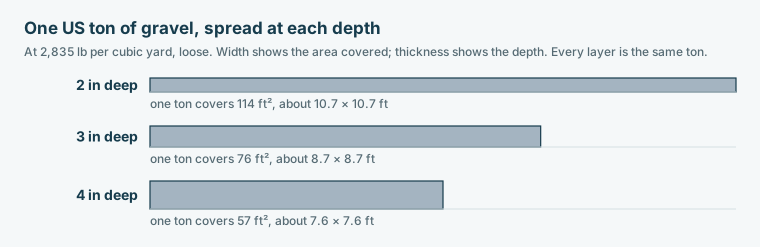
The coverage guide compares depth and density and reads suppliers’ coverage charts back into the weight per yard they assume. Read the gravel coverage guide →
Tons to cubic yards at 105 lb/ft³
Divide US tons by the material’s US tons per cubic yard. At the stated 105 lb/ft³, one US ton occupies about 0.71 yd³. This is a volume conversion; the area it covers also depends on depth.
| US tons | Cubic yards |
|---|---|
| 1 | 0.71 |
| 2 | 1.41 |
| 5 | 3.53 |
| 10 | 7.05 |
For another density, use yards = US tons × 2,000 ÷ (lb/ft³ × 27), or convert tons to yards for another material. Enter the resulting volume in Known volume if you want the calculator to estimate bags or quoted cost.
How many bags of gravel are in a cubic yard?
One cubic yard contains 27 ft³. Divide by the bag’s labelled volume, or divide the estimated weight by its labelled weight, then round up.
| Bag label | Bags |
|---|---|
| 0.5 ft³ | 54 |
| 40 lb | 71 |
| 50 lb | 57 |
The 0.5 ft³ result does not need density. The weight-labelled results do: 1 yd³ weighs 2,835 lb only at this assumed density. For pea gravel, use that product’s density and check our bags versus bulk buying guide.
How much gravel for 100, 200 or 500 square feet?
| Area | Depth | Volume | Bags |
|---|---|---|---|
| 100 ft² | 2 in | 0.62 yd³ | 34 |
| 100 ft² | 3 in | 0.93 yd³ | 50 |
| 100 ft² | 4 in | 1.23 yd³ | 67 |
| 200 ft² | 2 in | 1.23 yd³ | 67 |
| 200 ft² | 3 in | 1.85 yd³ | 100 |
| 200 ft² | 4 in | 2.47 yd³ | 134 |
| 500 ft² | 2 in | 3.09 yd³ | 167 |
| 500 ft² | 3 in | 4.63 yd³ | 250 |
| 500 ft² | 4 in | 6.17 yd³ | 334 |
Volume displays to two decimal places. Bag counts round up from the unrounded volume. Supplier bulk-order increments are not included.
Beyond a rectangle
How to calculate gravel for L-shaped areas, circles and metric measurements
These worked examples use assumed dimensions, no extra allowance and no compaction adjustment. They demonstrate the calculation; they do not prescribe a suitable layer depth. Open an example to load its measurements into the calculator and adjust them for your project.
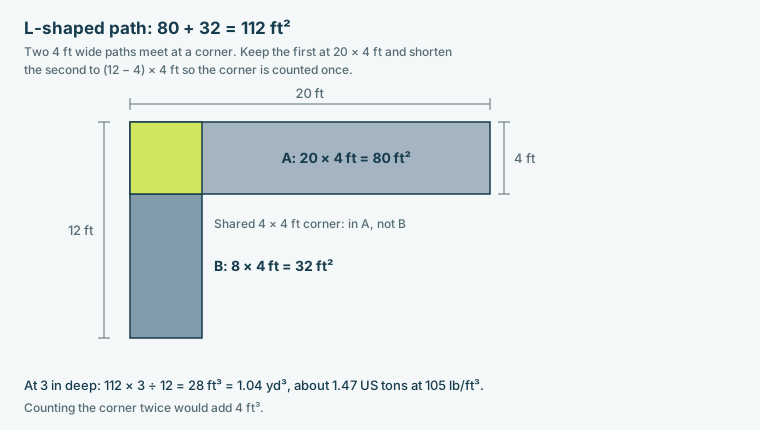
L-shaped path: split the area without counting the corner twice
Suppose two 4 ft wide paths meet at a corner. Their outside lengths are 20 ft and 12 ft. Counting both full rectangles would count the shared 4 × 4 ft corner twice. Keep the first rectangle at 20 × 4 ft and shorten the second to (12 − 4) × 4 ft, or 8 × 4 ft.
The area is 80 + 32 = 112 ft². At 3 inches deep, that is 112 × 3 ÷ 12 = 28 ft³, or 1.04 yd³. At 105 lb/ft³, the estimate is 1.47 US tons and 56 bags of 0.5 ft³. Counting the corner twice would add 4 ft³, equivalent to 8 extra bags. Use Add another area for the second rectangle; both areas must use the same material and density.
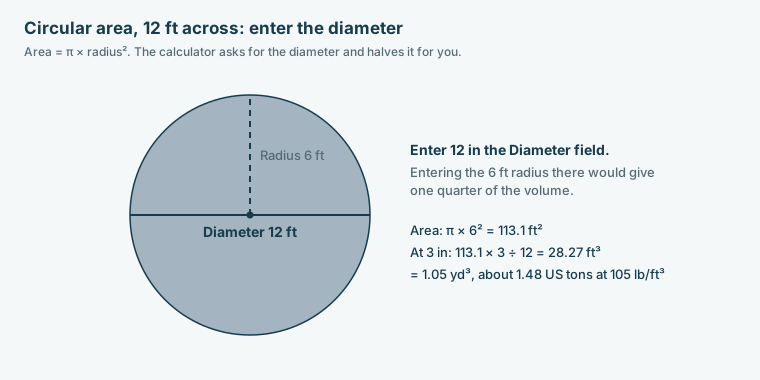
Circular area: use diameter, not radius
For a 12 ft diameter circle, the radius is 6 ft. At 3 inches deep, volume = π × 6² × (3 ÷ 12) = 9π ft³, or 1.05 yd³. At 105 lb/ft³, that is 1.48 US tons or 57 bags of 0.5 ft³, rounded up. Enter 12 in the calculator’s Diameter field. Entering the 6 ft radius there would produce only one-quarter of the correct volume.
Metric example: a 6 × 2 m area at 5 cm depth
Convert depth to meters: 5 cm ÷ 100 = 0.05 m. The volume is 6 × 2 × 0.05 = 0.6 m³. At a bulk density of 1,600 kg/m³, an example value rather than a conversion of the tool’s US default, the weight is 960 kg, or 0.96 metric tonnes. For bags labelled 20 kg, that is 48 bags.
Choose Metric, enter depth in centimeters and set the bag basis to weight. A 20 kg bag is not a 20 liter bag: a volume-labelled bag uses volume, while a weight-labelled bag needs a density to relate it to the area being covered.
Try the metric example (new tab) ↗Which input changes your order?
How depth, density and extra allowance change a gravel order
All four scenarios cover the same 20 × 10 ft area. The baseline uses 3 inches of depth, 105 lb/ft³ and 0% extra allowance. Each later row changes only the named input; the changes are not cumulative. The densities and allowance are illustrative, not recommended settings.
| Scenario | Volume (yd³) | US tons | 0.5 ft³ bags |
|---|---|---|---|
| Baseline: 3 in, 105 lb/ft³, 0% extra | 1.85 | 2.63 | 100 |
| Depth only: 4 in | 2.47 | 3.5 | 134 |
| Density only: 120 lb/ft³ | 1.85 | 3 | 100 |
| Allowance only: 10% | 2.04 | 2.89 | 110 |
- Depth changes volume and weight. Going from 3 to 4 inches adds one-third to both before rounding. Recheck depth measurements before trying to refine a weight estimate.
- Density changes weight, not geometric volume. The 120 lb/ft³ scenario needs the same cubic yards and volume-labelled bags as the baseline, but its weight is 14.3% higher. Weight-labelled bag counts and per-ton costs would increase too.
- Allowance increases the purchase quantity. A chosen 10% adds 5 ft³ to the baseline, which means 10 more 0.5 ft³ bags. It does not establish whether a compacted layer has been allowed for.
Table values are fixed examples calculated with the same formulas as the tool. Volume and weight display to two decimals; bag counts use the unrounded volume. See the supplier density reference for product-specific evidence and the calculation methodology for formulas.
How to turn a gravel estimate into an order: three checks
Top-ups need the missing depth
If an existing layer is uniformly 2 inches deep and your specified finished level is 3 inches, the geometric top-up is 1 inch. Over 200 ft², that is 200 × 1 ÷ 324 = 0.62 yd³ before allowance. Measure shallow and deep patches separately when the existing layer is uneven; entering 3 inches across the whole area would estimate a new full layer.
A supplier’s tons-per-yard figure needs a unit conversion
If a supplier quotes 1.4 US short tons per cubic yard, enter 1.4 × 2,000 ÷ 27 = 103.70 lb/ft³ in the US density field. Do not enter 1.4 directly: the field expects pounds per cubic foot. If the quote uses metric tonnes, confirm the mass and volume units before converting. The NIST unit conversion tables document the unit factors.
Displayed precision is not a supplier’s selling increment
A displayed 1.85 yd³ estimate does not mean the supplier sells hundredths of a yard. Confirm the minimum order and rounding increment before multiplying by a price. Bags round up automatically; bulk quantities do not. Use the dump truck load and minimum-order guide and bags-versus-bulk comparison to check the actual purchase quantity.
Material names and calculator inputs
Types of gravel: pea gravel, crushed stone, #57 stone and crusher run
A material name helps identify what to ask for, but it does not supply every input for an aggregate calculator. Particle grading and bulk density answer different questions: grading describes the mix of particle sizes; bulk density relates a delivered volume to its weight.
| Material | What to check and enter |
|---|---|
| Pea gravel | Check the specific product and bag label. Two suppliers can publish different weights for pea gravel. Choose the sourced pea gravel preset, or replace it with your supplier’s bulk density. |
| Crushed stone / #57 gravel | Confirm the specified grading and whether this is the exact stone your project requires. The crushed stone calculator and #57 stone calculator open with published weights for each; replace them with your supplier’s figure. |
| Crusher run / crush minus | Confirm the local product specification, including fines, and whether the depth is loose or compacted. The crusher run calculator shows the compaction arithmetic; apply only a supplier-confirmed allowance. |
| Road base / paver base / decomposed granite | These are compacted in place, so the loose volume you order is larger than the finished layer. The road base, paver base and decomposed granite calculators show published loose and compacted figures. |
| River rock / decorative gravel | Ask for the selected product’s size range, coverage guidance and delivered weight per yard. The river rock calculator and landscape rock calculator open with published weights; replace them with your supplier’s figure. |
For example, Lasalle’s pea gravel is listed at 2,700 lb/yd³, while South Bay’s 3/8-inch pea gravel is listed at 2,440 lb/yd³. Those give 1.35 and 1.22 US tons per yard, respectively. They describe those products, not a universal pea gravel density. See the density reference and recorded source dates.
For driveways, a drainage layer and a surface layer can need different gradings. FHWA’s Gravel Roads Construction and Maintenance Guide, Section III explains how coarse particles, sand-sized particles and fines contribute to surface gravel. Its granular base guidance also explains the relationship between grading and drainage. A quantity calculator does not select a construction specification.
How deep should gravel be, and how much extra should I order?
Start with the specified depth for your application: a decorative garden bed, pedestrian path and vehicle-bearing driveway are different jobs. For a driveway, obtain the base and surface layer specifications separately. For decorative rock, ask how the chosen stone size affects the coverage depth. Our 2-, 3- and 4-inch tables illustrate quantity changes; they are not a universal installation-depth chart.
Compaction and extra allowance are different calculations
Confirm whether the requested depth describes loose material or the finished compacted layer. If a supplier gives a loose-to-compacted volume multiplier, apply it to the geometric volume. If they instead give a percentage reduction of loose volume, divide by the remaining fraction. These percentages are not interchangeable.
Washington State DOT lists its crushed surfacing base at 2,950 lb per cubic yard loose and 3,700 lb compacted, a 20.27% reduction in volume. Filling 1 yd³ compacted therefore needs 3,700 ÷ 2,950 = 1.25 yd³ loose, a 25% increase; adding 20.27% would give only 1.2 yd³. That ratio belongs to WSDOT’s base course only; the road base calculator applies it to base layers.
The calculator starts at 0% allowance and applies no automatic compaction adjustment. Enter only the extra percentage you have chosen or confirmed. If you already converted a quantity to loose volume, use Known volume and avoid adding the same factor again. Supplier rounding and minimum loads are a separate question, covered in the dump truck load guide.
Pea gravel and driveway calculation examples
Pea gravel example: a 20 × 3 ft path
At 2 inches deep, this path needs 10 ft³, or 0.37 cubic yards. Using Lasalle Sand & Gravel’s pea gravel at 100 lb/ft³ gives 1,000 lb (0.5 US tons), or 20 bags of 0.5 ft³, with no extra allowance. The depth is an example, not an installation recommendation. For bag counts, 10 × 10 ft examples and coverage per ton, open the pea gravel calculator.
Driveway example: cost of one specified layer
A 40 × 12 ft layer 4 inches deep has a geometric volume of 160 ft³, or 5.93 cubic yards. At the general reference of 105 lb/ft³, that is 8.4 US tons before any extra allowance or compaction adjustment.
If the layer is crusher run, the 2 published crusher run lists that quote by the cubic yard give $54.22–$65.99; at their midpoint of $60.11, the unrounded volume costs $356.18 before delivery; the crusher run calculator shows those lists with a crusher run weight. Enter your own quote in Bag & cost options. Calculate different driveway materials separately and confirm the layer specification with your installer. Labor, equipment, taxes and minimum-order charges can add to the project cost. The dedicated gravel driveway calculator adds base and surface layer examples, a driveway length table and compaction arithmetic.
Before choosing bags or a bulk load, compare the full cost of bags versus bulk and check supplier delivery minimums.
Calculate your own gravel quantities ↑ · Review density sources and formulas
From quantity to price
To picture the delivery, see what a ton of gravel looks like, from pile size to pickup loads. For an installed driveway, the cost guide separates material, delivery and labor.
For the material alone, the gravel prices guide compares published 2026 prices per yard and per ton from 17 suppliers, with their delivery fees.
Read the gravel driveway cost guide →Before you order
Frequently asked questions about calculating gravel
The units matter. So do the assumptions.
Check our formulas & sources ↗How much gravel do I need?
Measure the surface area and multiply it by the gravel depth, using the same units. For a rectangle measured in feet and depth in inches, cubic yards = length × width × depth ÷ 324. Add any separately chosen extra allowance before ordering.
How many cubic feet are in a yard of gravel?
27. A cubic yard is 3 ft × 3 ft × 3 ft whatever the material, so one yard of gravel is 27 ft³. Spread 2 inches deep it covers 162 ft²; at 3 inches, 108 ft²; at 4 inches, 81 ft². Weight is a separate question that depends on the product’s density.
How much area does a ton of gravel cover?
At 105 lb/ft³, one US ton covers about 114.3 ft² at 2 inches deep and 76.2 ft² at 3 inches; the gravel coverage guide compares other depths and densities.
Which calculator should I use for pea gravel or #57 stone?
This one works for both: choose the sourced pea gravel or #57 stone reference under Material & allowance, or enter your supplier’s own weight. The dedicated pea gravel calculator opens with the pea gravel reference and counts bags, and the #57 gravel calculator compares two published #57 weights.
Can this estimate a gravel driveway?
It can estimate the volume of a specified driveway layer. A driveway may need multiple materials and compacted layers. Calculate each material separately; ask your supplier or installer how compacted design depth translates to loose material delivered. The gravel driveway calculator has layer-by-layer examples and a length table.
Does this calculator include compaction?
No automatic compaction factor is applied. Extra allowance is a percentage you choose for material beyond the geometric volume. It is not a universal compaction correction.
Are tons and tonnes the same?
No. US mode uses short tons of 2,000 pounds. Metric mode uses tonnes of 1,000 kilograms. Switching units converts the measurements, density and quote basis rather than just changing the labels.
How do I calculate gravel cost per yard versus per ton?
Multiply the quantity by the matching unit quote: cubic yards by price per cubic yard, or US tons by price per US ton. For the same material, price per US ton × US tons per cubic yard gives the equivalent price per cubic yard. Add delivery and check minimum orders, taxes and rounding separately. Published prices per ton or per yard are compared on the gravel prices page.
How much gravel does a 50 lb bag cover?
At an assumed 105 lb/ft³, a 50 lb bag contains about 0.476 ft³. It covers about 2.86 ft² at 2 inches deep or 1.90 ft² at 3 inches, before extra allowance or compaction. Use the density or coverage printed for your actual product; a 50 lb bag is not automatically 0.5 ft³.
References
- Gravel Roads Construction and Maintenance Guide, Federal Highway Administration, 2015. Surface gravel grading and layer guidance
- Granular base guidance, Federal Highway Administration
- NIST Guide to the SI, Appendix B.8: conversion factors, National Institute of Standards and Technology. Foot, yard, pound and short ton definitions used in every conversion
- Pea gravel · supplier reference: 100 lb/ft³; 3/4 inch crush minus · supplier reference: 96.3 lb/ft³, Lasalle Sand & Gravel. Based on Lasalle’s listed 2,700 lb per cubic yard. Other pea gravel products can differ. Based on Lasalle’s listed 2,600 lb per cubic yard. Not a #57 stone specification or a compaction factor.
- 3/4 inch crushed stone · supplier reference: 103.7 lb/ft³, LandCare Stone. Based on LandCare Stone’s listed 2,800 lb per cubic yard. Other 3/4 inch products are published at 2,600 lb.
- Crusher run · supplier reference: 90.74 lb/ft³, Yard Works Landscape Supply. Based on Yard Works’ approximate 2,450 lb per cubic yard, loose. Crusher run compacts in place; no compaction factor is applied.
- #57 stone · supplier reference: 89.26 lb/ft³, Gravelshop. Based on Gravelshop’s 2,410 lb per cubic yard for #57 limestone. A retailer conversion, not a grading specification.
- River rock · supplier reference: 98.15 lb/ft³, Steve Miller Inc. Based on Steve Miller’s 2,650 lb per yard for 3/4 inch river rock. Larger river rock is published from 2,000 to 3,000 lb.
- Landscape rock · supplier reference: 96.3 lb/ft³, Granite Landscape Centers. Based on the approximate 2,600 lb per yard for 3/4 inch decorative rock. Colour and stone type change the weight.
- Decomposed granite · supplier reference: 92.59 lb/ft³, Outdoor Warehouse Supply. Based on the approximate 2,500 lb per yard for 1/4 inch minus DG, loose. DG is compacted in place; no compaction factor is applied.
- Road base · supplier reference: 105.93 lb/ft³, Sutherland Landscape Supplies. Based on Sutherland’s listed 2,860 lb per yard, loose. Road base compacts in place; no compaction factor is applied.
- Paver base · supplier reference: 100 lb/ft³, Pavingstone Supply. Based on Pavingstone Supply’s average 2,700 lb per yard for crushed base gravel, loose. No compaction factor is applied.
- Earthwork volumes reference tables, Caterpillar. Dry 1/4–2 in gravel weight that supports the general default
- Design Manual M 22-01.23, Exhibit 620-1 (September 2024), Washington State Department of Transportation. Crushed surfacing base weights, loose and compacted, used in the compaction example
- Limestone with fines 21AA: $65.99 per cubic yard, Main's Landscape Supply, Southfield, MI. Crusher run price used in the driveway example. Recorded September 23, 2026
- Crusher Run (ABC): $54.22 per cubic yard, BOSS Boone One Stop Supply, Wake Forest, NC. Crusher run price used in the driveway example. Recorded September 23, 2026
About these calculations
By Site Measure · Maintained by Vincent Ruan · Last updated .
Written with AI assistance from the sources listed on this page. Each figure links to its source; recorded dates are shown with the figures or in the gravel weight and price ledgers, and the arithmetic is covered by automated tests. The 105 lb/ft³ default is a general estimate, not a product specification; the methodology gives its source. How this page was made · Report an error