Sourced density preset · bags, yards and tons
Pea gravel calculator
Enter your area and depth to get pea gravel in 0.5 ft³ bags, cubic yards and US tons.
The material reference is a published supplier figure, not a guess.
How much pea gravel you need
Enter your dimensions to see cubic yards, tons and bags
The short answer
How much pea gravel do I need?
Multiply length × width in feet by depth in inches, then divide by 324 to get cubic yards. A 10 × 10 ft area at 2 inches needs 16.67 ft³, or 0.62 cubic yards. That is 34 bags of 0.5 ft³, or about 0.83 US tons at the Lasalle Sand & Gravel reference of 100 lb/ft³ (2,700 lb per cubic yard). Under a play set the depth is 12 inches, and the order is measured in tons rather than bags.
At 2 inches deep, each square foot needs about 0.17 ft³, roughly 17 lb at this page's 100 lb/ft³ preset; at 3 inches, 0.25 ft³ or about 25 lb.
Depth by use
How deep should pea gravel be?
2 to 3 inches in a planting bed, 4 inches where it has to stop weeds and 12 inches under play equipment. Each figure below comes from a university extension service or the US Consumer Product Safety Commission.
| Use | Depth | Source |
|---|---|---|
| Mulch in planting beds | 2–3 in | Utah State University Extension, inorganic mulch |
| Mulch meant to suppress weeds | 4 in | Colorado State University Extension, any mulch |
| Under play equipment, falls up to 5 ft | 9 in after settling; install 12 in | CPSC Public Playground Safety Handbook, Table 2 |
The extension guides cited here do not give a separate depth for pea gravel paths and patios. Retail bags are written for about 2 inches: Vigoro says one 0.5 ft³ bag covers up to 2.75 ft², a layer 2.2 inches deep. Colorado State adds that stones must be no more than about half an inch across to work as mulch, which 3/8 inch pea gravel meets.
The calculation
How to calculate pea gravel
- Measure the area.Length × width in feet. Under play equipment, add 6 ft on every side of the equipment: that is the area CPSC says the surfacing must cover.
- Choose the depth for the use.2–3 inches as mulch, 4 inches to hold back weeds, 12 inches under a play set so it settles to 9.
- Find the volume.Square feet × depth in inches ÷ 12 gives cubic feet; divide by 27 for cubic yards.
- Convert to bags or tons.Cubic feet ÷ 0.5 for 0.5 ft³ bags, rounded up. For bulk, cubic feet × the supplier’s lb/ft³ ÷ 2,000 gives US tons.
Rectangle · US measurements
Length × Width × Depth ÷ 324
Feet × feet × inches → cubic yards
Cubic feet × 100 ÷ 2,000
Cubic feet × lb/ft³ → US tons at the reference density
Read the full calculation method ↗Worked examples
Pea gravel for a 10 × 10 patio and a 20 × 3 path
At 100 lb/ft³, before any allowance. Open one to load it into the calculator.
| Project | Volume | 0.5 ft³ bags | Weight |
|---|---|---|---|
| 10 × 10 ft at 2 in | 16.67 ft³ · 0.62 yd³ | 34 | 0.83 US tons |
| 10 × 10 ft at 3 in | 25 ft³ · 0.93 yd³ | 50 | 1.25 US tons |
| 20 × 3 ft path at 2 in | 10 ft³ · 0.37 yd³ | 20 | 0.5 US tons |
Going from 2 to 3 inches on the same 10 × 10 ft area adds 16 bags, a 50% increase. Depth changes the order more than any rounding decision.
Bags
How many bags of pea gravel do I need?
Bags are labelled either by volume, commonly 0.5 ft³, or by weight, commonly 50 lb. A volume label converts directly: cubic feet ÷ 0.5, rounded up. A weight label needs the product’s bulk density. At the 100 lb/ft³ reference the two labels happen to match (50 lb ÷ 100 lb/ft³ = 0.5 ft³), but a denser or wetter product gives fewer cubic feet per 50 lb bag. The calculator accepts either basis under Bag sizes & cost.
Bags for 100 square feet
| Depth | Cubic feet | Bags |
|---|---|---|
| 1 in | 8.33 ft³ | 17 |
| 2 in | 16.67 ft³ | 34 |
| 3 in | 25 ft³ | 50 |
| 4 in | 33.33 ft³ | 67 |
Coverage of one bag
| Depth | Coverage |
|---|---|
| 1 in | 6 ft² |
| 2 in | 3 ft² |
| 3 in | 2 ft² |
| 4 in | 1.5 ft² |
Bag labels and store listings for pea gravel and 3/8 in gravel imply 81 to 100 lb per cubic foot (about 2,190–2,700 lb per yard); the lightest, a store’s listed weight rather than a printed label, is below every bulk pea gravel figure in our ledger. Each label and its store listing are in what a 0.5 ft³ bag actually holds.
Under play equipment
How much pea gravel do I need for a playground?
More than most people expect, because safety guidance sets both the depth and the area. The US Consumer Product Safety Commission’s public playground handbook lists 9 inches of pea gravel as protecting falls up to 5 ft, says loose fill compresses at least 25% over time, and extends the surfacing at least 6 ft beyond the equipment in every direction. Install 12 inches so 9 remain.
| Area with the use zone | 22 × 20 ft = 440 ft² |
|---|---|
| Volume at 12 in | 440 ft³ = 16.3 yd³ |
| Weight | 22 US tons |
| In 0.5 ft³ bags | 880 bags |
Load the 22 × 20 ft area at 12 inches and change it to your own equipment. CPSC also advises against loose fill for toddlers’ play areas, notes that some loose fill may not meet accessibility guidelines, and over a hard surface calls for a 3–6 inch gravel drainage layer and a geotextile cloth under the loose fill.
Bulk quantities
How much does a ton or a cubic yard of pea gravel cover?
Bulk pea gravel is sold by the cubic yard or the US ton. At the 100 lb/ft³ reference, one cubic yard weighs 2,700 lb (1.35 US tons) and one US ton is 20 ft³, or 0.74 cubic yards.
| Depth | One US ton covers |
|---|---|
| 1 in | 240 ft² |
| 2 in | 120 ft² |
| 3 in | 80 ft² |
| 4 in | 60 ft² |
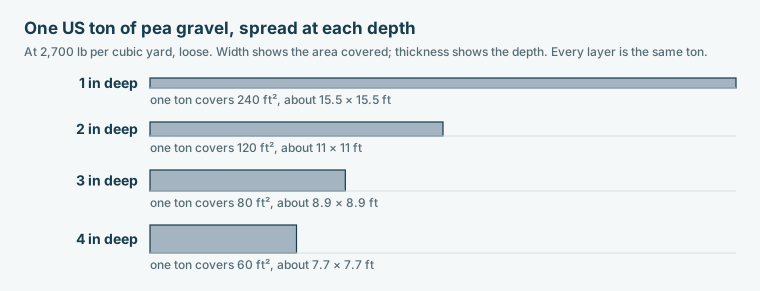
Coverage per ton depends on density: South Bay Materials publishes 2,440 lb per cubic yard for its pea gravel, which stretches one ton to 132.79 ft² at 2 inches. As a check, Front Range Material’s coverage chart says one ton of its pea gravel covers 83 ft² at 3 inches, against 80 ft² here; its figure implies 96.39 lb/ft³. For gravel in general, see how much a yard of gravel weighs, which lists each supplier weight per yard in our ledger with its source and recorded date.
Bags or bulk delivery?
One cubic yard is 54 bags of 0.5 ft³, and the playground above is 880. Beyond a few dozen bags, compare a delivered bulk quote. Our price list gives pea gravel cost per yard and per ton from published supplier lists; the bags versus bulk guide compares both per cubic yard, and the dump truck load guide covers minimum orders and short-load fees.
Planning the whole order? See what a ton of gravel looks like when it is dumped, and what a pickup can carry.
How much pea gravel do I need for a 10 × 10 area?
A 10 × 10 ft area is 100 ft². At 2 inches deep it needs 16.67 ft³, or 0.62 cubic yards: 34 bags of 0.5 ft³, or about 0.83 US tons at 100 lb/ft³. At 3 inches it needs 0.93 cubic yards, 50 bags or 1.25 US tons.
How much does a 50 lb bag of pea gravel cover?
About 3 ft² at 2 inches if the gravel weighs 100 lb/ft³, because 50 lb is then 0.5 ft³. Pea gravel labels differ: Pavestone Pea Gravel is 45 lb per 0.5 ft³ and Pavestone Pea Pebbles is 40.5 lb per 0.5 ft³, so a 50 lb bag of lighter gravel holds a little more.
How much does a yard of pea gravel weigh?
2,700 lb (1.35 US tons) at the 100 lb/ft³ preset. The 5 bulk pea gravel figures in our ledger run from 2,440 to 2,720 lb per cubic yard, so ask your supplier for the figure they bill by.
How much pea gravel is in a ton?
One US ton is 0.74 cubic yards (20 ft³) at 2,700 lb per yard, and 0.82 cubic yards at the lightest published figure, 2,440 lb.
Does pea gravel stop weeds?
It can, if it is deep and small enough. Colorado State University Extension says gravel mulch should be 4 inches deep to suppress weeds and that stones must be no more than about half an inch across to work as mulch, which 3/8 inch pea gravel meets. It also reports that pea gravel improves water infiltration, where larger rock increases runoff.
References
- Pea gravel · supplier reference: 100 lb/ft³, Lasalle Sand & Gravel. Recorded September 16, 2026
- Water-Wise Landscaping: Mulch (2007), Utah State University Extension. Recorded September 24, 2026
- Mulching, GardenNotes (reviewed April 2023), Colorado State University Extension. Recorded September 24, 2026
- Public Playground Safety Handbook, Publication 325 (November 2010), US Consumer Product Safety Commission. Recorded September 24, 2026
- 3/8 inch pea gravel: 2,440 lb per cubic yard, South Bay Materials. Recorded September 16, 2026
- Quikrete All-Purpose Gravel No. 1151 (3/8 in), McCoy's. Label recorded September 24, 2026
- Quikrete All-Purpose Gravel (3/8 in), Kellogg Supply. Label recorded September 24, 2026
- Pavestone Pea Gravel, Hemlock Hardware. Label recorded September 24, 2026
- Pavestone Pea Gravel, Kellogg Supply. Label recorded September 24, 2026
- Pavestone Pea Pebbles, Country Max. Label recorded September 24, 2026
- Vigoro Bagged Pea Gravel Pebbles, The Home Depot. Label recorded September 24, 2026
- Material Coverage & Conversion Chart, Front Range Material. Recorded September 24, 2026
About these calculations
By Site Measure · Maintained by Vincent Ruan · Last updated .
Written with AI assistance from the sources listed on this page. Each figure links to its source; recorded dates are shown with the figures or in the gravel weight and price ledgers, and the arithmetic is covered by automated tests. Preset: 100 lb/ft³. Based on Lasalle’s listed 2,700 lb per cubic yard. Other pea gravel products can differ. How this page was made · Report an error