Base rock for driveways and pads · tons, yards, lifts
Road base calculator
Enter length, width and depth to calculate road base in cubic yards and US tons. The preset is a published weight of 2,860 lb per cubic yard, loose. For a compacted depth, add about 25%, and lay it in lifts no thicker than 6 inches.
How much road base you need
Enter your dimensions to see cubic yards, tons and bags
The short answer
How much road base do I need?
Multiply length × width in feet by depth in inches, then divide by 324 for cubic yards. A 12 × 40 ft driveway base at 4 in needs 160 ft³, or 5.93 cubic yards, which is about 8.47 US tons at the Sutherland Landscape Supplies figure of 2,860 lb per cubic yard (1.43 tons per yard). Enter your finished depth, then set the extra allowance to about 25% under Material & allowance if that depth is compacted.
Same material, local names
What is road base called in your state?
Road base is dense-graded crushed stone: every size from the top stone down to dust, with a set share of fines passing the No. 200 sieve. Each state highway agency grades it a little differently and gives it its own name.
| State | Name in the spec | Top size | Fines (No. 200) |
|---|---|---|---|
| California | Class 2 aggregate base R-value at least 78; 2–9% fines as the operating range. California yards sell Class 2 aggregate base as “Class 2 base rock” (Lyngso publishes 1.5 US tons/yd³) | 1½ in or ¾ in maximum | 0–12% |
| Kentucky | DGA (dense graded aggregate) | 1 in | 4–13% |
| Maryland | Graded aggregate base (GAB) | 2 in | 0–8% |
| New Jersey | DGA (dense-graded aggregate) | 1½ in | 3–10% |
| New York | Subbase course, Type 2 Crushed or blasted ledge rock | 2 in | 0–10% |
| North Carolina | ABC (aggregate base course) | 1½ in | 4–12% |
| Ohio | Item 304 / Item 411 2013 edition | 2 in / 1½ in | 0–15 / 3–15% |
| Pennsylvania | 2A | 2 in | 0–10% |
| Texas | Flexible base, Item 247 Grade 1–2 Texas grades by percent retained: 85–95% retained on No. 200 | 2½ in (0–10% retained on 1¾ in) | 5–15% |
| Virginia | 21A / 21B | 2 in | 6–12 / 4–7% |
Yards use their own names on top of these. On the price lists behind this page, road base is sold as Class 5 Road Gravel (Forest Lake, MN), Crushed Limestone 1.5 inch minus (Houston, TX), Granite Road Base (Class 6) (Denver, CO), Road Base Class 6 (Denver, CO), ABC Road-base (Apache Junction, AZ). Virginia and Maryland specify crusher run as a separate product; see the crusher run calculator.
The calculation
How to calculate road base
- Ask for your state’s base by name.Road base is dense-graded crushed stone, and each state grades it a little differently. The table above gives the name and fines limit in 10 state specifications.
- Measure and set the compacted depth.Length × width in feet, and the finished thickness in inches from your plan.
- Add the compaction allowance.Multiply the compacted cubic yards by 1.25, the loose volume per compacted yard in WSDOT’s published weights, then by the product’s pounds per yard ÷ 2,000 for tons.
- Split it into lifts.Spread and compact no more than 6 inches at a time: an 8 inch base goes down as 2 lifts of 4 inches.
Rectangle · US measurements
Length × Width × Depth ÷ 324
Feet × feet × inches → cubic yards
Cubic yards × 2,860 ÷ 2,000
Cubic yards × lb/yd³ → US tons at the reference weight
Read the full calculation method ↗Worked examples
Road base calculator examples
At 105.93 lb/ft³, before any allowance. Open one to load it into the calculator.
| Project | Volume | Weight |
|---|---|---|
| 12 × 40 ft driveway base at 4 in | 160 ft³ · 5.93 yd³ | 8.47 US tons |
| 20 × 20 ft parking pad at 6 in | 200 ft³ · 7.41 yd³ | 10.59 US tons |
| 10 × 12 ft shed pad at 4 in | 40 ft³ · 1.48 yd³ | 2.12 US tons |
Bulk quantities
How much does a ton or a cubic yard of road base cover?
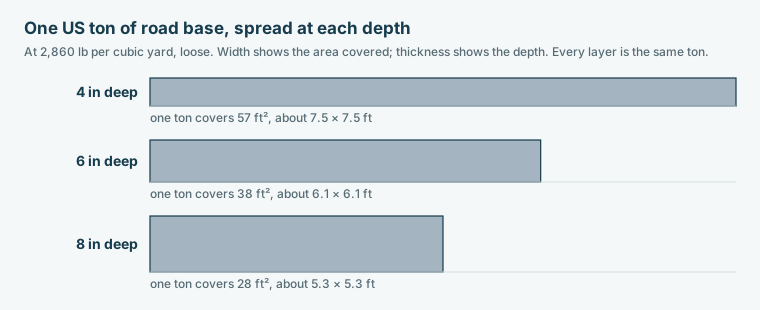
One US ton at 2,860 lb per cubic yard is 0.7 cubic yards (18.88 ft³).
| Depth | One US ton covers | Tons for 100 ft² |
|---|---|---|
| 4 in | 56.64 ft² | 1.77 tons |
| 6 in | 37.76 ft² | 2.65 tons |
| 8 in | 28.32 ft² | 3.53 tons |
Why the density matters
How much does a yard of road base weigh?
One cubic yard of road base weighs 2,600 to 3,000 lb (1.3 to 1.5 US tons) across the published figures below, and 2,860 lb (1.43 US tons) at the calculator’s preset.
| Product | Publisher | lb per yd³ | Tons per yd³ |
|---|---|---|---|
| Road Base | Sutherland Landscape Supplies | 2,860 | 1.43 |
| Virgin Class 2 Base Rock | Lyngso Garden Materials | 3,000 | 1.5 |
| Recycled Road Base, 1.5 inch minus | Rock N Yard | 2,600 | 1.3 |
| Crushed Surfacing Base Course, truck measure | Washington State DOT | 2,950 | 1.48 |
Enter your supplier’s figure under Material & allowance. For gravel in general, see how much a yard of gravel weighs, which lists each supplier weight per yard in our ledger with its source and recorded date.
Published prices
How much does road base cost?
Public price lists from 5 suppliers give $99.99 per cubic yard (1 list) and a median of $40.48 per ton ($28.50–$45.00, 4 lists), before delivery. At this page’s reference weight of 2,860 lb per yard, the per-ton median works out to about $57.88 per cubic yard.
| Supplier | Product | Price |
|---|---|---|
| Bracht Bros Forest Lake, MN | Class 5 Road Gravel | $28.50 per ton Pickup; plus county tax |
| Texas Garden Materials Houston, TX | Crushed Limestone 1.5 inch minus | $99.99 per cubic yard Pickup; delivery at checkout |
| Bedrock Landscaping Materials Denver, CO | Granite Road Base (Class 6) | $45.00 per ton Delivery extra (flat fee by distance) |
| Ainsworth Rock Sales Denver, CO | Road Base Class 6 | $39.95 per ton Delivery and tax not stated |
| AZ Rock Express Apache Junction, AZ | ABC Road-base | $41.00 per ton Delivery by zone and tonnage |
Per-ton and per-yard prices are not comparable until you convert with the product’s own weight per yard. Delivery fees, minimum orders and the other materials we track are on the gravel prices page.
Loose versus compacted
Road base compaction: how much loose material to order
Washington State DOT’s design manual lists crushed surfacing base course at 2,950 lb per cubic yard loose (truck measure) and 3,700 lb compacted, both dry. The same tonnage therefore occupies 1.25 times as much space on the truck as in the finished layer.
| Compacted depth | Loose depth to spread | Loose yd³ per 100 ft² |
|---|---|---|
| 3 in | 3.76 in | 1.16 yd³ |
| 4 in | 5.02 in | 1.55 yd³ |
| 6 in | 7.53 in | 2.32 yd³ |
| 8 in | 10.03 in | 3.1 yd³ |
One agency’s figure for one specification; moisture and grading change it. For a driveway with separate base and top layers, use the gravel driveway calculator.
Building it
How to compact road base: lifts and density
Three state specifications cap a compacted layer at 6 inches. A thicker base goes down in equal lifts, each spread loose and compacted before the next.
| Compacted depth | Lifts | Each lift compacted | Spread loose per lift |
|---|---|---|---|
| 4 in | 1 | 4 in | 5.02 in |
| 6 in | 1 | 6 in | 7.53 in |
| 8 in | 2 | 4 in | 5.02 in |
| 10 in | 2 | 5 in | 6.27 in |
| 12 in | 2 | 6 in | 7.53 in |
- Virginia DOT §309.05: Not more than 6 in compacted per layer; two or more equal layers when the base is thicker (10 in with approved special compactors).
- Caltrans §26: No layer thicker than 0.50 ft compacted; two roughly equal layers when the base is thicker.
- NYSDOT CIM 304: In confined areas, 6 in compacted at most; each loose lift at least 1.5 × the largest stone, or 6 in.
How dense each lift must be
- Caltrans: At least 95% relative compaction, every layer.
- TxDOT: At least 100% of maximum dry density, within ±2.0% of optimum moisture.
- VDOT: 100%, 95% or 90% of maximum density when 0–50%, 51–60% or 61–70% of the base is retained on the No. 4 sieve; optimum moisture ±2 points.
Water is part of the weight you buy: New Jersey rejects DGA wetter than 8% when it pays by the ton, and at that moisture a delivered ton carries about 148 lb of water.
Before you order
Frequently asked questions about road base
How deep should road base be?
Your plan sets the total; the specifications set how it goes down. Virginia, California and New York cap each compacted layer at 6 inches, and Caltrans and TxDOT compact every layer to 95–100% of maximum density. Under a paver patio, ICPI’s minimum is 4 inches of compacted base; see the paver base calculator. For a driveway, the gravel driveway calculator covers layer depths.
How thick should each layer of road base be?
No more than 6 inches compacted. VDOT requires two or more equal layers when the base is thicker than 6 inches, Caltrans caps a layer at 0.50 ft, and NYSDOT’s inspection manual sets the same 6 inch limit in confined areas with each loose lift at least 1.5 times the largest stone.
How many tons of road base per cubic yard?
Published loose figures on this page run from 2,600 lb (1.3 tons) to 3,000 lb (1.5 tons) per cubic yard. Recycled road base is at the light end. WSDOT lists crushed surfacing base course at 2,950 lb loose and 3,700 lb compacted, dry.
How much extra road base do I need for compaction?
Using WSDOT’s published dry weights, a compacted cubic yard holds 3,700 ÷ 2,950 = 1.25 loose yards, so order about 25% more than the compacted volume. Put another way, the layer loses about 20% of its loose volume.
Is road base the same as crusher run?
Not in Virginia or Maryland, which specify crusher run separately with looser limits on fines; elsewhere yards use the names loosely, so ask which specification the product meets. The crusher run calculator compares the two gradings.
Does moisture change what I pay for road base by the ton?
Yes, because water is weighed with the stone. New Jersey places its DGA at 6 ± 2% moisture and refuses deliveries wetter than 8% when it pays by weight. At 8%, a delivered ton carries about 148 lb of water.
References
- Road Base: 2,860 lb/yd³, Sutherland Landscape Supplies. Recorded September 23, 2026
- Virgin Class 2 Base Rock: 1.5 US tons/yd³, Lyngso Garden Materials. Recorded September 23, 2026
- Recycled Road Base, 1.5 inch minus: 1.3 US tons/yd³, Rock N Yard. Recorded September 23, 2026
- Crushed Surfacing Base Course, truck measure: 2,950 lb/yd³, Washington State DOT. Recorded September 23, 2026
- Road and Bridge Specifications 2020, Virginia Department of Transportation. Checked September 24, 2026
- 2026 Standard Specifications, Table 901 A, Maryland Department of Transportation State Highway Administration. Checked September 24, 2026
- Standard Specifications 2019, Volume 4, Table 733-04A, New York State Department of Transportation. Checked September 24, 2026
- Construction Inspection Manual, Section 304: Subbase Course, New York State Department of Transportation. Checked September 24, 2026
- Aggregates 101 webinar: PennDOT 2A gradation chart (January 21, 2021), Penn State Center for Dirt and Gravel Road Studies. Checked September 24, 2026
- 2019 Standard Specifications, Section 805: Dense Graded Aggregate, Kentucky Transportation Cabinet. Checked September 24, 2026
- 2013 Construction and Material Specifications, 703.17 and 703.18, Ohio Department of Transportation. Checked September 24, 2026
- Standard Specifications, Section 26: Aggregate Bases (MnDOT-hosted copy), California Department of Transportation. Checked September 24, 2026
- 2018 Standard Specifications, Table 1005-1, North Carolina Department of Transportation. Checked September 24, 2026
- 2024 Standard Specifications, Item 247: Flexible Base, Texas Department of Transportation. Checked September 24, 2026
- Standard Specifications 2007, §901.10 Dense-Graded Aggregate, New Jersey Department of Transportation. Checked September 24, 2026
About these calculations
Written with AI assistance from the sources listed on this page. Each figure links to its source; recorded dates are shown with the figures or in the gravel weight and price ledgers, and the arithmetic is covered by automated tests. The 2,860 lb per cubic yard preset is Sutherland Landscape Supplies’ published weight for its own road base. The compaction ratio comes from WSDOT Design Manual Exhibit 620-1. How this page was made · Report an error