Layer by layer · depth, tons and truckloads
Gravel driveway calculator
Enter the driveway length, width and one layer’s depth to get cubic yards and US tons.
Plan on at least 4.5 inches of gravel on firm ground, 6.5 on soft.
How much driveway gravel you need
Enter your dimensions to see cubic yards, tons and bags
The short answer
How much gravel do I need for a driveway?
For each layer, multiply length × width in feet by depth in inches and divide by 324 to get cubic yards. A 12 × 40 ft driveway at 4.5 inches, the lightest gravel thickness the FHWA gravel roads guide suggests, is 180 ft³, or 6.67 cubic yards: about 9.45 US tons at the 105 lb/ft³ starting estimate from Site Measure (1.42 tons per cubic yard). On a soft subgrade the guide suggests 6.5 inches: 13.65 tons, more than one 10-ton truckload.
Depth
How deep should a gravel driveway be?
At least 4.5 inches of gravel on firm ground and 6.5 inches on a soft subgrade, for a road that sees up to five heavy trucks a day. That is Table 3 of the FHWA Gravel Roads Construction & Maintenance Guide (2015), the thickness it suggests when no engineer has designed the road. Driveway rules published by towns and road commissions land in the same range or deeper.
FHWA suggested minimum gravel thickness
| Heavy trucks a day | Subgrade | Gravel |
|---|---|---|
| 0–5 | Low | 6.5 in |
| 0–5 | Medium | 5.5 in |
| 0–5 | High | 4.5 in |
| 5–10 | Low | 8.5 in |
| 5–10 | Medium | 7 in |
| 5–10 | High | 5.5 in |
The same depths on a 12 × 40 ft driveway
| Depth | Cubic yards | US tons | 10-ton loads |
|---|---|---|---|
| 6.5 in | 9.63 | 13.65 | 2 |
| 5.5 in | 8.15 | 11.55 | 2 |
| 4.5 in | 6.67 | 9.45 | 1 |
Published driveway and gravel-surface depths
| Source | Applies to | Depth |
|---|---|---|
| FHWA Gravel Roads Guide (2015) | Surface course of any gravel road | At least 3 in, to leave material for blade maintenance |
| FHWA Gravel Roads Guide (2015) | Each layer as it is placed | Loose lifts of no more than 4 in (up to 8 in with larger compactors), and at least twice the top stone size |
| Penn State Center for Dirt & Gravel Roads (2025) | Driving Surface Aggregate on low-volume roads | One 6–8 in loose lift, compacted with a vibratory roller |
| Vermont Standard B-71, via West Fairlee, VT | Gravel driveway within the road right-of-way | 12 in of sub-base and a 6 in aggregate surface course |
| Lapeer County Road Commission, MI (2022) | Gravel driveway approach in the right-of-way | At least 8 in of MDOT 21AA, 22A or 23A aggregate |
| Alexandria Township, MN, Ordinance 113 | Residential driveway | 4–6 in of Class 5 aggregate |
| City of Garland, TX | Compacted gravel or crushed rock driveway | At least 6 in, contained within a distinct border |
Place thick layers in lifts: the FHWA guide keeps each loose lift to about 4 inches with ordinary compaction equipment, and at least twice the size of the largest stone. Crown the surface so water runs off: about 0.5 inch per foot of width (about 4%, never above 6%). On a 12 ft driveway crowned in the middle, that puts the centre 3 inches above the edges.
Right-of-way and approach rules cover the part of a driveway that meets a public road; check your own town’s permit before building.
The calculation
How to calculate driveway gravel in four steps
- Measure each section.Length × width in feet for every straight run, turnaround or parking pad. Add them as separate areas above rather than treating the widest dimensions as one rectangle; see how to split an L-shaped area.
- Set each layer’s depth.Start from the depth table above: at least 4.5 inches of gravel in total, with a surface course of 3 inches or more. Use your town’s rule where it asks for more.
- Calculate one layer at a time.Square feet × depth in feet gives cubic feet; divide by 27 for cubic yards. Multiply cubic feet by the product’s bulk density and divide by 2,000 for US tons.
- Count the truckloads.Divide the tons by what your supplier’s truck carries and round up. Loads above 10 tons need a larger truck or a second trip.
Rectangle · US measurements
Length × Width × Depth ÷ 324
Feet × feet × inches → cubic yards, per layer
Cubic feet × 105 ÷ 2,000
Cubic feet × lb/ft³ → US tons at the starting estimate
Read the full calculation method ↗Worked examples
Driveway gravel examples: 12 × 40 ft and 20 × 20 ft
At 105 lb/ft³, with no allowance. Open a row to load it into the calculator. For the base layer alone, the road base calculator adds a published compaction allowance.
| Layer | Volume | Weight |
|---|---|---|
| 12 × 40 ft, one 4.5 in layer | 180 ft³ · 6.67 yd³ | 9.45 US tons |
| 20 × 20 ft, one 4 in layer | 133.33 ft³ · 4.94 yd³ | 7 US tons |
| 12 × 40 ft, 4 in base layer | 160 ft³ · 5.93 yd³ | 8.4 US tons |
| 12 × 40 ft, 3 in surface layer | 120 ft³ · 4.44 yd³ | 6.3 US tons |
The base and surface rows share one density only to show the volume split; replace it with each product’s own figure and keep the two estimates separate.
By driveway length
How much gravel for a 20, 50, 100 or 200 ft driveway?
A 12 ft wide driveway at the FHWA guide’s 4.5-inch and 6.5-inch thicknesses, at 105 lb/ft³. Scale by width for a wider drive.
| Length | At 4.5 in | At 6.5 in |
|---|---|---|
| 20 ft | 3.33 yd³ · 4.73 t | 4.81 yd³ · 6.83 t |
| 50 ft | 8.33 yd³ · 11.81 t | 12.04 yd³ · 17.06 t |
| 100 ft | 16.67 yd³ · 23.63 t | 24.07 yd³ · 34.13 t |
| 200 ft | 33.33 yd³ · 47.25 t | 48.15 yd³ · 68.25 t |
Coverage
Coverage per ton at driveway depths
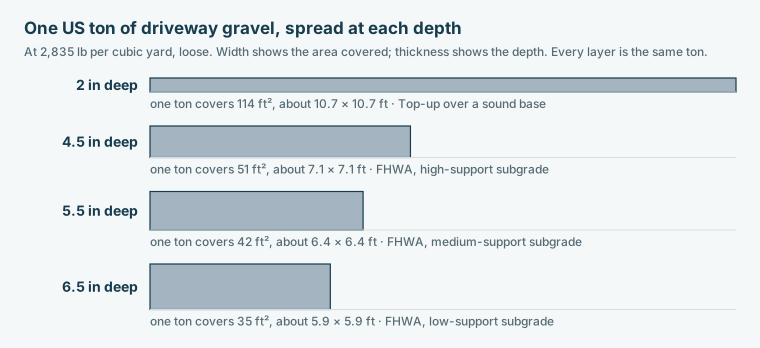
At 105 lb/ft³, one US ton is 19.05 ft³, or 0.71 cubic yards, spread over less area the deeper the layer. The depths below are the FHWA guide’s suggested totals for light traffic, plus 2 inches to top up a sound driveway; the gravel coverage guide covers other depths and weights.
| Depth | One US ton covers |
|---|---|
| 2 in Top-up over a sound base | 114.29 ft² |
| 4.5 in FHWA, high-support subgrade | 50.79 ft² |
| 5.5 in FHWA, medium-support subgrade | 41.56 ft² |
| 6.5 in FHWA, low-support subgrade | 35.16 ft² |
Denser products cover less per ton; see how much a yard of gravel weighs for published supplier weights. The FHWA guide warns to allow for shrinkage: loose gravel on the truck settles when it is compacted, so order the compacted depth plus an allowance (WSDOT’s base-course weights imply about 25.42% extra).
Gravel driveway cost calculator: use your own quote
Open Bag & cost options, enter your supplier’s price per cubic yard or per ton and the delivery charge, and the calculator prices the unrounded quantity. For scale: published figures for a basic installed gravel driveway run $1–$4 per square foot, or $480–$1,920 for 12 × 40 ft. The gravel is the small part of that: one Ohio yard delivers 10 tons of crusher run for $375.
What an installed gravel driveway costs, and what the price covers →
Is 2 inches of gravel enough for a driveway?
Not as the only layer. The FHWA gravel roads guide sets 3 inches as the minimum for a surface course alone and suggests at least 4.5 inches of gravel in total on a firm subgrade. Two inches can top up a driveway that already has a sound base.
How much crown should a gravel driveway have?
About half an inch per foot of width, roughly 4%, and never more than 6%, according to the FHWA guide; Penn State’s dirt and gravel roads program specifies 4–6%. On a 12 ft driveway crowned in the middle, half an inch per foot puts the centre 3 inches above the edges.
How many dump truck loads of gravel for a driveway?
At 6.5 inches the 12 × 40 ft driveway is 13.65 tons, 2 loads from a yard that caps each at 10 tons; the dump truck load guide lists published truck capacities and delivered prices.
Does the driveway calculator include compaction?
No. If your depth is a compacted depth, order extra loose material. Washington State DOT lists crushed surfacing base at 2,950 lb per cubic yard loose and 3,700 lb compacted, a 20.27% volume reduction. At that ratio the 6.67 yd³ example needs 8.36 yd³ loose. Enter the extra as the allowance once.
Should I calculate the base and surface layers together?
Separately. On the same 12 × 40 ft footprint, a 4-inch base is 5.93 cubic yards and a 3-inch surface 4.44 cubic yards. Each layer is usually a different product with its own weight and price, so run one estimate per material.
References
- Gravel Roads Construction and Maintenance Guide (2015), Federal Highway Administration. Table 3 gravel thickness, the 3 inch surface minimum, lifts and crown. Recorded September 24, 2026
- Driving Surface Aggregate on low-volume roads, Penn State Center for Dirt & Gravel Roads (2025). One 6–8 in loose lift, compacted with a vibratory roller. Recorded September 24, 2026
- Gravel driveway within the road right-of-way, Vermont Standard B-71, via West Fairlee, VT. 12 in of sub-base and a 6 in aggregate surface course. Recorded September 24, 2026
- Gravel driveway approach in the right-of-way, Lapeer County Road Commission, MI (2022). At least 8 in of MDOT 21AA, 22A or 23A aggregate. Recorded September 24, 2026
- Residential driveway, Alexandria Township, MN, Ordinance 113. 4–6 in of Class 5 aggregate. Recorded September 24, 2026
- Compacted gravel or crushed rock driveway, City of Garland, TX. At least 6 in, contained within a distinct border. Recorded September 24, 2026
- Design Manual M 22-01.23, Exhibit 620-1 (September 2024), Washington State Department of Transportation. Crushed surfacing base, 2,950 lb per cubic yard loose and 3,700 lb compacted. Recorded September 23, 2026
- General gravel: 105 lb/ft³, Site Measure. Site Measure’s general starting value; Caterpillar’s dry 1/4–2 in gravel, 2,850 lb per loose yd³ (105.6 lb/ft³) supports it. Not a product specification.
- Installed gravel driveway, $1–$3 per sq ft, LawnStarter, cost guide. Materials and labor; grading and excavation priced separately. Updated December 27, 2025. Recorded September 23, 2026
- Installed gravel driveway, $1.25–$4.00 per sq ft; most projects $500–$3,500, HomeAdvisor, cost guide. Professional installation. Updated June 17, 2026. Recorded September 23, 2026
- Installed gravel driveway, $2.18–$2.99 per sq ft (pea gravel), Homewyse, cost guide. Basic labor and material, at least 2 inches, favorable site; no excavation. May 2026. Recorded September 23, 2026
- Installed gravel driveway, $2.00 per sq ft (501–1,000 sq ft); $1.75 (1,001–2,500 sq ft), Denver Concrete Inc., Denver, CO, contractor. Full-service gravel driveway; road base is priced higher. No date shown. Recorded September 23, 2026
- Delivered B-19 3/4 inch crusher run, by the ton, Colson’s Gravel, Morrow, OH. Material and delivery within 20 miles; $50 surcharge beyond. Recorded September 24, 2026
About these calculations
By Site Measure · Maintained by Vincent Ruan · Published , updated .
Written with AI assistance from the sources listed on this page. Each figure links to its source; recorded dates are shown with the figures or in the gravel weight and price ledgers, and the arithmetic is covered by automated tests. Depths, crowns, weights, installed costs and delivered prices come from the references above; the 105 lb/ft³ starting estimate is a general figure, not a product specification. How this page was made · Report an error